Chicago
The Journey CollectionChicago functions as the principal emergency stop in Travis McCoy and Russ McCoy’s troubled return journey. Reached only after mechanical problems canceled the practicality of their direct flight, the city transforms travel into a prolonged sequence of uncertainty: a hurried transfer, an overnight possibility of being stranded, and a choice that threatens to separate the two companions even after they have endured the disruption together.
Arrival and Transit
Travis McCoy and Russ McCoy reach Chicago on a replacement route after their original flight becomes unusable because of mechanical trouble and the delay in obtaining another jet. Their new itinerary sends them to a flight leaving for Chicago in ten minutes, from which they must attempt to continue toward Dallas on standby. They accept the arrangement because it appears to be the only chance of reaching home that night, and Travis offers a brief prayer for better luck at the next destination.
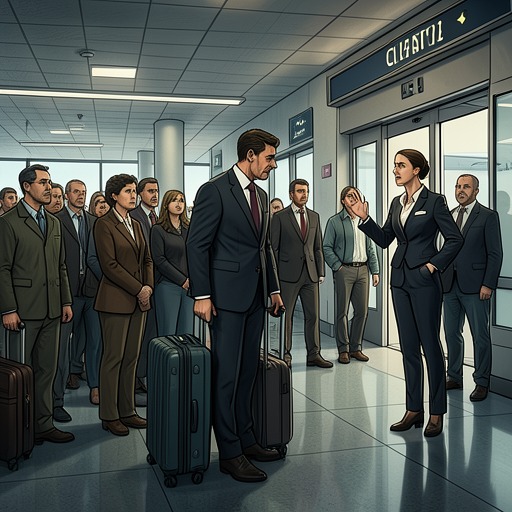
The arrival does not provide relief. Their plane lands at Terminal B, while the possible connecting flight is in Terminal C, forcing them to wait nearly twenty minutes for a transfer van. A blast of frigid air strikes them as they leave the terminal area, an especially harsh contrast to the warmth associated with their departure from Miami. Once across the tarmac, they discover that their gate lies at the far end of the terminal and rush through the crowd with their carry-on bags.
A City of Delay
Chicago is presented less as a destination than as a maze of logistical obstacles. Travis McCoy and Russ McCoy must negotiate separate terminals, a distant gate, standby procedures, and the possibility that no seat will become available. While Russ McCoy checks the status of their pending flight, Travis McCoy calls Penelope Stone and explains that the direct Dallas flight has failed and that even the Chicago connection remains uncertain.
Their waiting becomes physically and emotionally wearing. They walk through the terminal considering their options, eventually settling for pizza and coffee before returning to the search for a flight out. The modest meal offers only a temporary pause; it does not resolve the central problem of whether either man will get home. Chicago therefore extends the journey’s suspense by replacing forward movement with repeated postponement.
The Threat of Separation
The next flight leaves without them, and their frustration with the airline grows strong enough that they again consider renting a car and driving. At the moment when their patience is nearly exhausted, an attendant calls Travis McCoy’s name and offers him a seat—but not one for Russ McCoy. The apparent solution contains a new cost: Travis McCoy can continue toward home alone, or he can accept a later flight and remain with his friend.
Russ McCoy tells Travis McCoy to take the flight and get home, placing Travis’s return above their shared itinerary. The exchange makes Chicago a moral pressure point rather than merely a transportation setting. The city forces the journey to test whether reaching home is an individual objective or a responsibility shaped by companionship. The evidence leaves the immediate decision at this point, but the dilemma clarifies the emotional stakes of the journey: mechanical failure and airline scheduling have become a possible rupture between two people who have endured the trip together.
Narrative Significance
Chicago’s narrative importance comes from the contrast between expectation and result. Travis McCoy and Russ McCoy expect a direct route to Dallas; instead, they are diverted through a city defined by cold, distance, waiting, and uncertain boarding status. Each attempted solution produces another obstacle, so the journey advances only through persistence rather than control.
The setting also gives concrete form to the book’s recurring emphasis on returning home. Home is not reached through a smooth or heroic passage but through disrupted flights, hurried movement across an airport, improvised food, and the possibility that one traveler must sacrifice his own progress for another. Chicago is consequently a threshold in the journey: a place where the destination remains visible in intention but repeatedly recedes in practice, while loyalty becomes as important as arrival itself.